

Why You Need an AI Operating Model to Scale Safely—and How Overlook Enables It
10/1/2025
Intro: The gap between AI pilots and enterprise AI
Many organizations today are stuck in the pilot purgatory—having built a few promising AI proofs-of-concept but failing to scale them reliably across the business. This isn’t lack of ML talent or computational horsepower; the real barrier is operational readiness.
Three recent thought leadership pieces—from Tribe.ai, McKinsey, and Deloitte—all converge on the idea that success in AI isn’t just about building models: it’s about how you structure, govern, and operate AI systems across the organization.
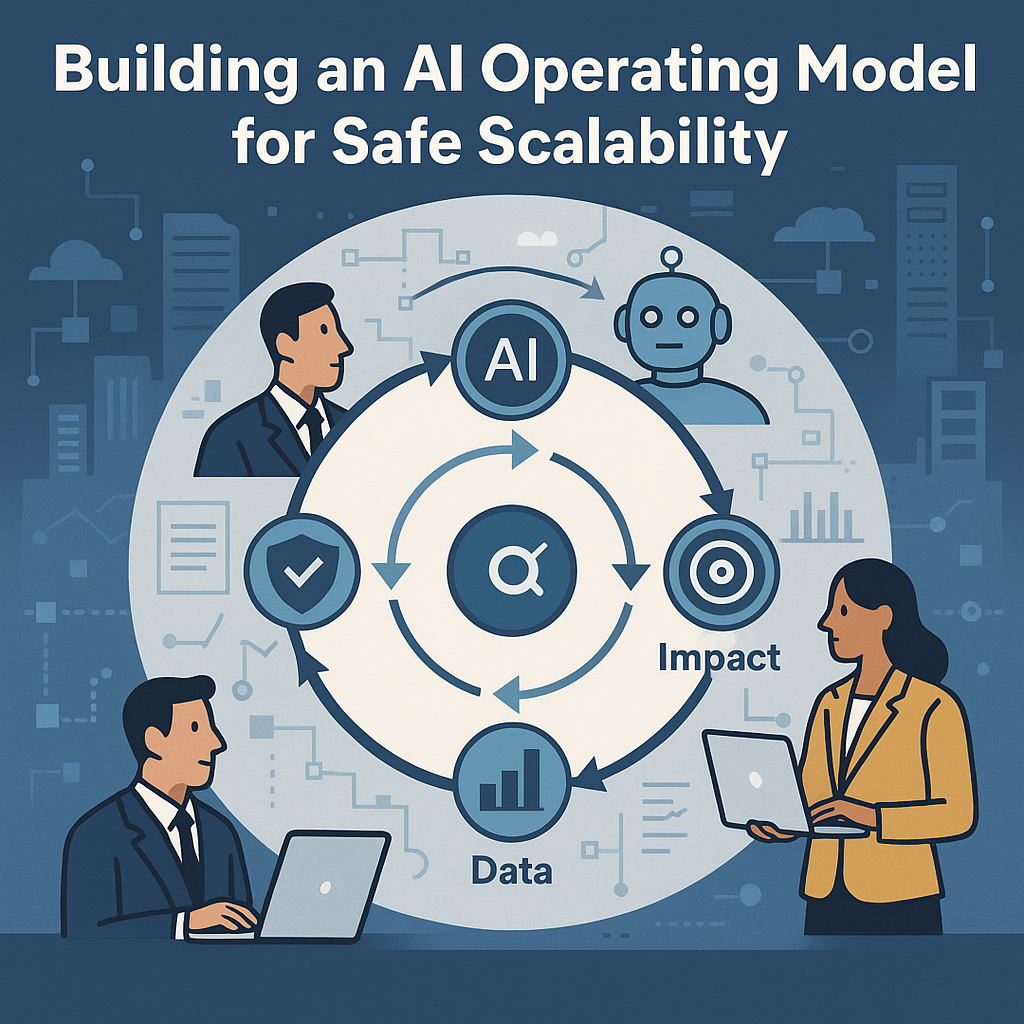
At Overlook, we call this your AI Operating Model—the set of processes, roles, data flows, feedback loops, and guardrails that let AI run at enterprise scale while maintaining trust, risk visibility, and business impact.
Let’s explore the key dimensions of a mature AI operating model, what common pitfalls to watch out for, and how Overlook’s platform maps directly into each pillar.
1. Organizational alignment: building a bridge between business & data
From McKinsey’s view: Scaling generative AI demands empowering data leaders who act as mediators among IT, business functions, risk/compliance, and engineering. Too often, AI is siloed under data science teams with weak cross-functional ties, which limits adoption and oversight.
Overlook’s stance: We believe AI must live in a shared domain—not just ML teams—but across product, operations, and executive leadership. Our Team’s Experience module ensures accountability, role clarity, and a traceable governance chain.
Pitfall: letting AI ownership stray exclusively to engineering, leaving business users in the dark.
2. Governance & lifecycle: from experiment to sustainable operation
Deloitte’s insights: The AI operating model must define lifecycle guardrails—from inception, validation, deployment, monitoring, to evolution. Each stage demands aligned policies, thresholds, and accountability.
Tribe’s emphasis: Operating models should structure around capabilities (e.g. retraining, drift detection, scenario orchestration) rather than just technical components.
How Overlook helps:
- Operating AI Record to unify provenance, model behavior logs, approvals, and runtime evidence
- Directed Evolution to continuously tie model updates back to scenario outcomes and business KPIs
- Risk Assessments & Alignment to embed risk scoring and team alignment in each stage
3. Data & model strategy: the “fuel” of your AI engine
McKinsey underscores that data readiness is often the bottleneck when scaling AI: data quality, lineage, versioning, and feature pipelines matter more than model hype.
Overlook tracks Data & Tailored Models explicitly in context of the scenario, with schema, lineage, and lifecycle metadata. That way, your models are always grounded in traceable, auditable data foundations.
Evolution is guided: new models must justify themselves against impact metrics, not just technical metrics.
4. Monitoring, validation & impact feedback loops
Deloitte warns that “deploy and forget” is a path to model decay, drift, and blind spots.
Tribe positions scenario-based validation as essential to catch edge cases and guarantee intended behavior.
Overlook offers a full validation loop:
- Scenario Design & Validation lets you compare expected vs actual behaviors
- Impact Measurement rolls up real-time metrics + qualitative feedback into unified Impact Scores
- These scores feed back to Govern & Operate and Directed Evolution to guide next actions
5. Scaling and operationalizing AI: orchestration, reuse & composability
All three sources stress that true scale comes from reusing assets, automating orchestration, and removing manual handoffs.
Overlook supports this via AI Asset Reuse (cataloging behaviors, datasets, models) and AI Agent for Operating AI that can dynamically discover tools/APIs and generate plans with risk awareness and human checkpoints.
This lets teams move faster without sacrificing the controls CFOs, COOs, or compliance would demand.
Conclusion: From models to running value
The difference between AI as a novelty and AI as a strategic, high-impact capability lies in your operating model. Without that scaffolding, adoption stalls, errors multiply, and trust erodes.
Overlook isn’t just a logging or deployment tool. It’s purpose-built to embed that operating model — tying governance, evolution, validation, and impact measurement together — so that you scale AI confidently.
If your org is struggling to make models live in impact, let’s talk about how Overlook can make your AI operations safe, governed, and outcome-driven.